
Free reference
FACS yfirlitsblað
A visual guide to the Facial Action Coding System (FACS) and beyond: every action unit (AU) with a reference GIF, the muscles involved, and notes, plus actions FACS leaves out (marked #notFACS).
All actions are performed by the author, FACS-certified with 14 years of experience in facial muscle isolation.
# ekki FACS marks actions I have identified and named that do not exist in FACS. FACS was built to identify facial behavior, so it lacks documentation for some finer movements. To fill the gaps, I define my own: lip cincher (vertical lip tightener), y-axis and z-axis dimpler, open-eyed blink, and more. These distinctions are especially useful for lipsync technology and photoreal characters.
All actions at a glance
All 43 actions in one table, in numerical order, with #notFACS actions at the end. Select an action to jump to its entry.
| Code | Action | Muscle(s) | Region |
|---|---|---|---|
| AU1 | innri augabrúnalyftari | frontalis, medial | Brows & forehead |
| AU2 | ytri augabrúnalyftari | frontalis, lateral | Brows & forehead |
| AU4 | lækka augabrún | hnúðvöðvi augabrúnar, niðursetjandi vöðvi augabrúnar og/eða beinastöðuvöðvi | Brows & forehead |
| AU5 | lyftari fyrir efri loku | lyftir efri augnlokinu | Augu og kinnar |
| AU6 | Kinnarhækkari | orbicularis oculi, orbital | Augu og kinnar |
| AU7 | Lokunarþjöppari | orbicularis oculi, preseptal palpebral | Augu og kinnar |
| AU8 | varirnar að hvorri annarri | hringvöðvi munnsins | Vörur |
| AU9 | nefrukkur | lyftir efri varar og neflipar | Nose & mid-face |
| AU10 | efri varahækkari | levator labii superioris (LLS) | Nose & mid-face |
| AU11 | Dýpkar nasolabíalbrúnina | smáskygóbeinið | Nose & mid-face |
| AU12 | Vörturykkjarahorn | stór kinnarbeinsvöðvi | Löpphorn |
| AU13 | beittur varadráttartæki | levator anguli oris (LAO) | Löpphorn |
| AU14 | dýpari að hluta til #notFACS | blásari | Löpphorn |
| AU15 | Læbhornsþrýstari | depressor anguli oris (DAO) | Löpphorn |
| AU16 | neðri vörulyftari | depressor labii inferioris (DLI) | Lower lip & chin |
| AU17 | Hökuhækkari | hugur | Lower lip & chin |
| AU18 | vörtukrepp | incisivus labii inferioris & incisivus labii superioris | Löpphorn |
| AD19 | tungusýning | it depends | Action descriptors |
| AU20 | vörurúlla | hláturvægur | Löpphorn |
| AU21 | hálsþrýstir | platysma | Misc |
| AU22 | vörurennari | orbicularis oris, peripheral | Vörur |
| AU23 | Varalokari | orbicularis oris, marginal | Vörur |
| AU24 | vörþrýstir | orbicularis oris, marginal | Vörur |
| AU25 | Vörður skiljast | it depends | Misc |
| AU26 | kjálkinn féll | relaxation of masseter, temporalis, medial pterygoid | Kinn |
| AU27 | Munnteygja | lateral pterygoid + suprahyoids | Kinn |
| AU28 | Vörtur sjúga | orbicularis oris, marginal + peripheral | Vörur |
| AD29 | jaw thrust | medial & lateral pterygoid, some masseter | Kinn |
| AD30 | jaw sideways | medial & lateral pterygoid, temporalis | Kinn |
| AU31 | jaw clencher | temporalis, masseter, medial pterygoid | Kinn |
| AD32 | biti | it depends | Action descriptors |
| AD33 | blása | it depends | Action descriptors |
| AD34 | blása, þensa, þensla, þenslu | it depends | Action descriptors |
| AD35 | suga | it depends | Action descriptors |
| AD36 | kúla | it depends | Action descriptors |
| AD37 | lip wipe | it depends | Action descriptors |
| AU38 | Nefgatsvíkkari | dilator naris (alar nasalis) | Nose & mid-face |
| AU39 | Nefholuþjöppu | compressor naris (transverse nasalis) + depressor septi | Nose & mid-face |
| AU45 | blikka | orbicularis oculi, palpebral + relaxation of LPS | Augu og kinnar |
| AU46 | Augnblik | hringvöðvi augans | Augu og kinnar |
| Eyrun upp og aftur # ekki FACS | auricular muscles | Brows & forehead | |
| opna augun og blikka # ekki FACS | orbicularis oculi, pretarsal palpebral | Augu og kinnar | |
| varaskerari # ekki FACS | orbicularis oris, marginal | Vörur |
Brows & forehead

AU1 innri augabrúnalyftari
Frontohliðavöðvi (medial part)
Action: Innri augabrúnalyftari lyftir innri hluta augabrúnar og enni.
Note: Inner brow raiser is variable in wrinkle formation and range. This variability is due to a number of factors, a prominent factor being Breytileiki framhálsliðarvöðvans.
Inner Brow Raiser Deep Dive →The Secret Life of Inner Brow Raiser →In the FACS Study Guide →

AU2 ytri augabrúnalyftari
Frontohliðavöðvi (lateral part)
Action: Ytri augabrúnalyftari lyftir hliðarröku og enni.
Note: As with inner brow raiser, outer brow raiser is variable in wrinkle formation and range. This variability is due to a number of factors, a prominent factor being Breytileiki framhálsliðarvöðvans.

AU4 lækka augabrún
Lögunarvöðvar augabrúnar, lækkarar augabrúnar og/eða miðvöðvi augabrúnar
Action: Augabrúnalækkari knits (corrugator supercilii) and lowers (procerus, depressor supercilii, and parts of corrugator supercilii) the brow area and lower central forehead.
Note: Brow lowerer can be performed by any or all of the muscles listed above. Though FACS lumps together the actions of all three muscles, Þegar ég kenni andlitslíffærafræði og FACS, ég aðskil hreyfingarnar.

Eyrun upp og aftur
# ekki FACS
auricular muscles (see notes)
Action: Eyrun upp og aftur lyftir eyrunum og ýtir þeim aftur.
Note 1: This is not a FACS action. I include this ear movement in the FACS yfirlitsblað because I see it happen relatively often.
Note 2: There are multiple auricular muscles. The superior auricular moves the ears up. The posterior auricular moves the ears back. The anterior auricular moves the ears forward. At present, I cannot separate these movements. The reference here shows posterior auricular + superior auricular movement.
Augu og kinnar

AU5 lyftari fyrir efri loku
levator palpebrae superioris muscle (LPS)
Action: Upphækkari efri loks dregur efri augnlokið upp og aftur til að víkka augun.
All About Upper Lid Raiser (members) →All About Upper Lid Raiser: preview (free) →Stylized Facial Expression Design →In the FACS Study Guide →

AU6 Kinnarhækkari
orbicularis oculi muscle, orbital part
Action: Kinnarhækkari Þröngvar ytri hringi augnholunnar og þrýstir á hliðarkantana.

AU7 Lokunarþjöppari
orbicularis oculi muscle, preseptal part of the palpebral area
Action: Lokunarþjöppari Þröngvar hringina um augnlokin og ýtir húð neðri augnloksins að innri hornum augnanna.

opna augun og blikka
# ekki FACS
orbicularis oculi muscle, pretarsal part of the palpebral area
Action: Opna augun og blikka Þrýstir innri hringina um augnlokin með hringhreyfingu að innri hornum augnanna.
Note: The pretarsal area is the portion of the orbicularis oculi muscle involved in blinking.
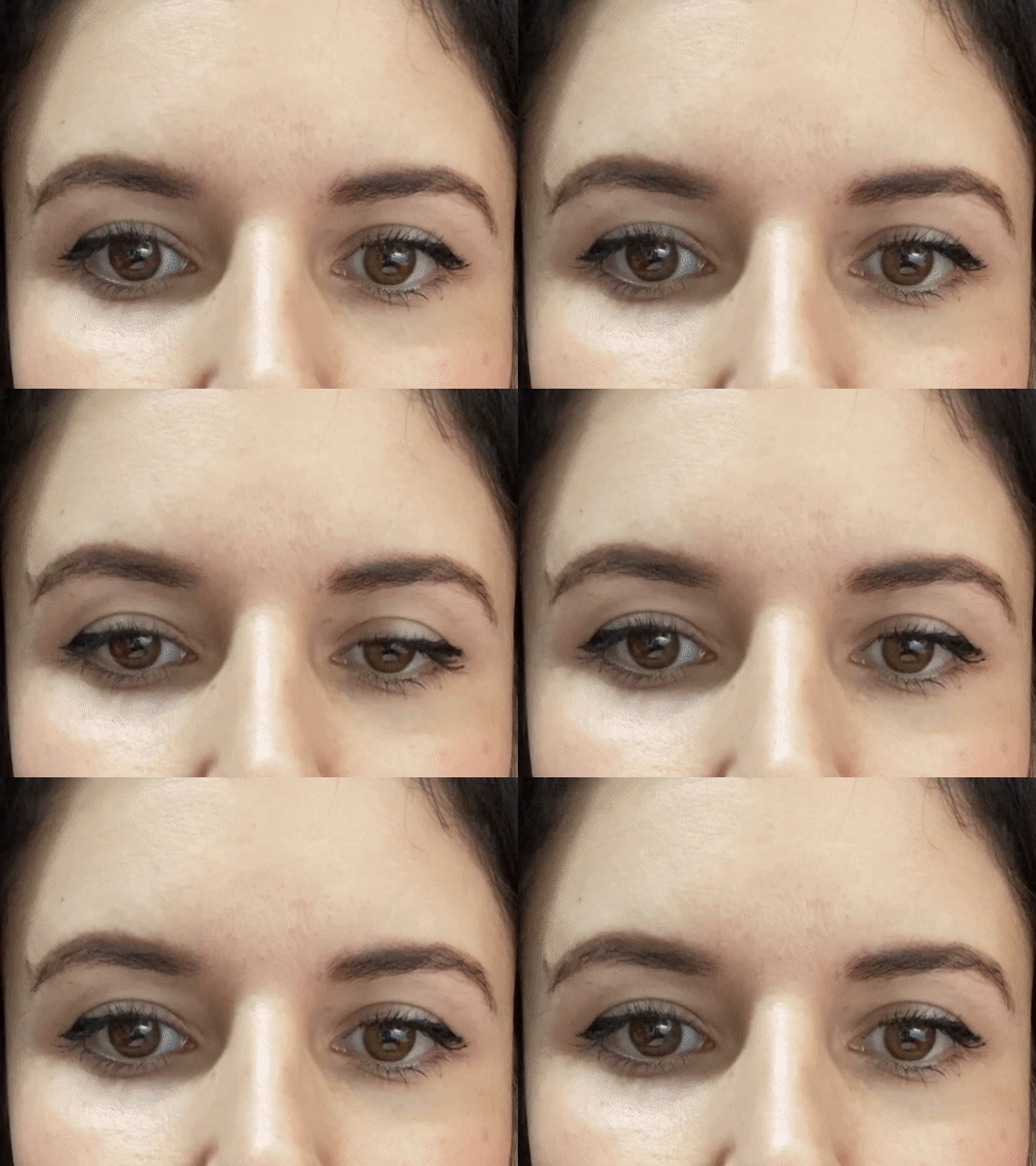
AU45 blikka
orbicularis oculi, palpebral part + relaxation of levator palpebrae superioris
Action: Blikkaðu lokar og opnar augun á snöggum, fljótlegum hátt.
Note: Beyond pretarsal activation, blikka also often consists of (1) relaxation of levator palpebrae superioris and/or (2) forced closure from the preseptal portion of orbicularis oculi.

AU46 Augnblik
hringvöðvi augans
Action: Augnblik Hylur annað augað, venjulega með þrýstingi.
Read the full note
Note: Unless you are a facial coder conducting behavioral research (and even then, the official FACS Manual lists AU46 wink as “optional”), the FACS shape for wink is not the most useful. I include it because other FACS lists include it; however, I find it to be a clunky, unnecessary addition to most shape sets. That being said, orbicularis oculi does deserve better functional breakdowns beyond cheek raiser, blink, and lid tightener, but wink is not the way to go.
Nose & mid-face


AU9 nefrukkur
levator labii superioris alaeque nasi (usually co-activates with depressor supercilii and/or procerus)
Action: Nöshrukkarinn lyftir hliðum nefsins, nösum og miðhluta efri varar.
Note: The brow lowering you see in nefrukkur er ekki beint orsakað af vöðvanum levator labii superioris alaeque nasi (LLSAN). Heldur er það orsakað af augabrúnarlækkunarvöðvum sem oft eru paraðir við nefrukkur: depressor supercilii og procerus. Tengslin milli þessara vöðva og LLSAN eru misjöfn.

AU10 efri varahækkari
levator labii superioris (LLS)
Action: Efri varahækkari lifts the top lip in a manner more lateral than nefrukkur en meira innar en Dýpkar nasolabíalbrúnina.
Upper Lip Raiser vs. Nasolabial Furrow Deepener (members) →Preview (free) →In the FACS Study Guide →

AU11 Dýpkar nasolabíalbrúnina
smáskygóbeinið
Action: Dýpkar nasolabíalbrúnuna lyftir og teygir efri varirnar (á hliðlægari og skáari hátt en nefrukkur eða efri varahækkari).
Upper Lip Raiser vs. Nasolabial Furrow Deepener (members) →Preview (free) →In the FACS Study Guide →

AU38 Nefgatsvíkkari
dilator naris (alar portion of nasalis)
Action: Nösvíkkari expands and widens the nostril wings, allowing for deeper air intake.

AU39 Nefholuþjöppu
compressor naris (transverse portion of nasalis) + depressor septi
Action: Nefholuþjöppu þröngvar nefvængina og lækkar oft neflenduna.
Löpphorn

AU12 Vörturykkjarahorn
stór kinnarbeinsvöðvi
Action: Vörturykkjarar dregur horn varaskanna upp, aftur og til hliða.

AU13 beittur varadráttartæki
lyftir horninu á munni
Action: Beittur varadráttartæki (áður þekkt sem kinnabólgi) draws the lip corners upward.

superior + inferior portions of buccinator

posterior portion of buccinator

inferior + superior + posterior portions of buccinator
AU14 dýpari
að hluta til #notFACS
Búkínatorvöðvi
Action: y-axis type: Dimpler pinches the lip corners against each other on a vertical plane.
Action: z-axis type: Dimpler draws the lip corners back against the teeth.
Note: y-axis and z-axis dimplers are not FACS-official terms. Classic FACS describes dýpari sem y+z-ásasamsetningartýpa.
Why I coined the y and z distinctions (members) →Video reference: front, 3/4, intraoral, and slow motion (free) →

AU15 Læbhornsþrýstari
depressor anguli oris (DAO)
Action: Læbhornsþrýstari dregur horn varaskanna niður.

AU18 vörtukrepp
incisivus labii inferioris & incisivus labii superioris
Action: Varahnykkur draws the lip corners medially, causing the fleshy part of the lips to collect toward the midline of the face and protrude.
Note 1: Incisivus labii superioris and incisivus labii inferioris are considered accessory muscles to orbicularis oris.
Note 2: Varahnykkur Algengt er að samvirkja varaskerari (vertical lip tightener). This example features both vörtukrepp og varaskerari. See varaskerari.

AU20 vörurúlla
hláturvægur
Action: Vörurúlla dregur horn munnsins út til hliðar og teygir kjöltuhluta varanna.
Note 1: Not to be confused with Munnteygja, which refers to forced (not due to relaxation) jaw lowering.
Note 2: Risorius is one of the most variable facial muscles in humans. Depending on the study, it has been reported missing in anywhere from 1 to 94% of research subjects. Risorius is narrow and difficult to locate, so this discrepancy may be partly inflated by methodological errors. Fyrir frekari upplýsingar um líffræðilega breytileika, bókaðu fyrirlestur í stúdíó um fjölbreytileika andlitsvöðva..
Leveraging Facial Muscle Variation →In the FACS Study Guide →
Lower lip & chin

AU16 neðri vörulyftari
depressor labii inferioris (DLI)
Action: Niðurvarpi neðri varar dregur neðri varirina niður og út til hliðar.

AU17 Hökuhækkari
hugur
Action: Hökuhækkari pulls up the lower lip and chin area.
Note: The lower lip may protrude to a degree in some instances of Hökuhækkari; however, if you see significant protrusion in a person attempting Hökuhækkari, þeir valda líklega einnig óæskilegum samdrætti í vöðva sem umlykur munnopið.
Video reference: frontal, 3/4, intraoral, and slow motion (free) →In the FACS Study Guide →
Vörur
These actions all come from orbicularis oris, the muscle that rings the mouth.

AU8 varirnar að hvorri annarri
hringvöðvi munnsins
Action: Vörur hvorri að annarri Fær efri og neðri varirnar saman með því að lækka efri varirnar og lyfta neðri varirnar.
Note 1: Vörur hvorri að annarri brings the lips back together from actions that may separate them. In this reference, AU26 kjálkinn féll separates the lips, and AU8 closes the lips while the jaw stays open.
Note 2: In tools like ARKit and Android XR, AU8 is solely used to counteract the lip opening caused by AU26. On real faces, AU8 is not limited to counteracting jaw opening: it can counteract anything that separates the lips. For instance, if a strong AU9 causes the lips to part, AU8 can bring the lips together while retaining other aspects of AU9.

AU22 vörurennari
orbicularis oris, peripheral part
Action: Vararennil Stýfur varirnar fram og breiðir þær út.

AU23 Varalokari
orbicularis oris, marginal part
Action: Varastrammi þynnir varirnar. Hugsaðu um það sem efra varir og neðra varir sem hvor um sig hrynur yfir sig.
Note: Not to be confused with varaskerari, which constricts the lips toward the midline of the face.

varaskerari
# ekki FACS
orbicularis oris, marginal part
Action: Vörur sem þrengja varir Þröngvar varirnar að miðlínu andlitsins.
Note: Lip cincher is not in official FACS. I previously called it lóðrétt varakantþrengjandi tæki, since FACS lumps it in with AU23. Only horizontal tightening qualifies as Varalokari in original FACS. I separate the two because the lips tighten in distinct manners. Orbicularis oris has rich variation in fiber direction, which yields more potential actions than have been documented so far. The distinction is especially useful when breaking down speech.

AU24 vörþrýstir (or “lip pressor”)
orbicularis oris, marginal part
Action: Vörþrýstir presses the top and bottom lips against each other.
Read the full note
Note: You may see vörþrýstir spelled “lip pressor” in many sources. This variation can be attributed to Paul Ekman’s inconsistent documentation. The FACS Investigator’s Guide from 1978 has one instance of “lip pressor” (on page 6, a page ripe with differently spelled FACS actions such as “lip tightner” for Varalokari, “lip puckerer” for vörtukrepp, “cheek puffer” for beittur varadráttartæki, and “lip suck” for Vörtur sjúga). The official 2002 FACS-handbók solely uses “lip presser.” To further ail the prescriptivist mind, Ekman’s post-2002 writings (e.g. Hvað andlitið afhjúpar, 2005) revert to the 1978 “pressor” spelling. Circa 2020, I asked Ekman’s protégé, Erika Rosenberg, whether “presser” or “pressor” was the canon spelling; her answer was that the spelling mattered less than the attribution of the AU number. The jury is still out, so we’ll have to wait at the edge of our seats for the next release of the FACS-handbók til að leysa þetta þrýstingur efni.
Lip presser asymmetries in speech: M-B-P Bilabial Visemes →In the FACS Study Guide →

AU28 Vörtur sjúga
orbicularis oris, marginal and peripheral parts
Action: Vörur sjúga dregur varirnar inn í munnopið og vefur þær utan um tennurnar.
Note 1: AU17 chin raiser appears during the in-between steps. I cannot perform this action without help from AU17 during the transition to the final pose, and mentalis likely shows up during lips suck for many others as well.
Note 2: Kinnin féll er næstum alltaf krafist fyrir Vörtur sjúga.
Kinn

AU26 kjálkinn féll
relaxation of masseter, temporalis, and medial pterygoid
Action: Kinnin féll lowers the mandible (jaw) in a relaxed (unforced) manner.

AU27 Munnteygja
lateral pterygoid and the suprahyoid (anterior digastric, geniohyoid, and mylohyoid)
Action: Munnteygja forcefully lowers the mandible (jaw). Unlike AU26, AU27 is not due to relaxation.
Read the full note
Note: Because “mouth” can colloquially refer to the lips and/or the jaw, Munnteygja is easily confused with similarly named actions like vörurúlla. Watch the naming in toolkits such as ARKit and ICT-FaceKit, both of which renamed AU20 vörurúlla sem Munnteygja (haha). The Munnteygja in ARKit and ICT-FaceKit is not the original Munnteygja from FACS. It is unfortunate that Munnteygja (1) was named so poorly to begin with, and (2) that ARKit and ICT-FaceKit made it worse with name swapping. A more pointed name like “jaw stretch” would have suited it better. Ultimately, it is what it is, so be careful out there.

AD29 jaw thrust
medial & lateral pterygoid and some masseter
Action: Kinnarþrýstingur pushes the mandible (jaw) forward.
Note: “AD” stands for action descriptor, a less fleshed-out action unit that works more as an event descriptor.

AD30 jaw sideways
medial & lateral pterygoid and temporalis
Action: Kinn hliðlægt moves the mandible (jaw) to the side (either left or right).

AU31 jaw clencher
temporalis, masseter, and medial pterygoid
Action: Kinnartennubiti brings the mandible (jaw) upward, pressing it against the upper jaw (maxilla).
Misc

AU21 hálsþrýstir
platysma
Note: You may see some AU20 lip stretcher in the AU21 hálsþrýstir example and vice versa. This is due to the close relationship between the risorius and platysma muscles.

AU25 Vörður skiljast
it depends
Note: In FACS, AU25 Vörður skiljast refers to the state of the lips being parted. Any action that separates the lips can cause it, e.g. relaxation of mentalis, relaxation of orbicularis oris, or contraction of other muscles.
Action descriptors
“AD” stands for action descriptor. An action descriptor is a less fleshed-out action unit (AU). ADs work more as event descriptors than as single muscle actions.

AD19 tungusýning
it depends

AD32 biti
it depends

AD33 blása
it depends

AD34 blása, þensa, þensla, þenslu
it depends

AD35 suga
it depends

AD36 kúla
it depends

AD37 lip wipe
it depends
Want it taught, not just referenced?
Course
FACS-kúrsnám
A high-density, visually driven FACS intensive. Saves months of research and reference hunting. Designed for rewatch. Built for long-term reference.
More reference guides
Stills, GIFs, side-by-side comparisons, and in-depth notes for each action.
Members
How to cite this page
For citations to track correctly, please refer to the Opinber skrá á Google Scholar.
APA
Ozel, M. (2020, febrúar). FACS yfirlitsblað. Snúðu þér að FACS. https://melindaozel.com/facs-cheat-sheet/
BibTeX
@misc{ozel2020facs, author = {Ozel, Melinda}, title = {FACS Cheat Sheet}, year = {2020}, month = feb, howpublished = {\url{https://melindaozel.com/facs-cheat-sheet/}} }References & further reading
- Hjortsjö, C.-H. (1970). Andlit manns og líkamsmál. Studentlitteratur.
- de Sanctis Pecora, C. (2020). One21: A novel, customizable injection protocol for treatment of the forehead with IncobotulinumtoxinA. Klínísk, snyrtifræðileg og rannsóknarhúðlækning, 13, 127–136. https://doi.org/10.2147/ccid.s237519
- Ekman, P., Friesen, W. V., og Hager, J. C. (2002). Kerfi til kóðunar andlitshreyfinga. Rannsóknartengill.
- Netter, F. H. (2019). Atlas of human anatomy (7. útgáfa). Elsevier.
- Standring, S., & Tubbs, S. R. (2025). Gray’s anatomy. Elsevier.